
Search “eco resort Bali” and the results blur into the same handful of ingredients: bamboo walls, an open-air bathroom, a hammock over a rice field, the word “eco” stamped onto almost every listing regardless of what happens behind the reception desk. The property you choose decides how much of that turns out to be real.
That scepticism is backed by more than instinct. Recent reports found that travellers booked more than 100 million room nights at properties holding a genuine third-party sustainability certification in 2025, yet roughly a third still say they doubt the sustainability claims hotels and villas make. It's one of the biggest reasons travellers are learning to look past the label and check what a property actually does.
For anyone planning an eco stay in Bali, East Bali offers a different scene from Ubud's busier bamboo cluster. Around Selat and Karangasem, rice terraces, mountain views, and slower days shape a different kind of low-impact stay, one built around fewer structures and more space between them.
This guide goes through Bali's best eco stays by type: treehouses, bamboo houses, glamping tents, jungle villas and private-pool retreats, naming the properties travellers already compare, including a few of our own houses.
A stay earns the word honestly when five things line up: what it is built from, where the water and waste go, how it is powered, who it employs, and how much land it disturbs to exist. None of this shows up in a photograph, which is exactly why it gets skipped over.
Materials and build. Bamboo grown and treated properly can stand for decades, but untreated bamboo rots within a year or two, so it's worth asking whether a property uses treated poles or is quietly replacing huts on a short cycle. We've written more on how bamboo houses are built if you want the construction detail.
Water and waste. A genuinely low-impact stay treats or reuses greywater, composts kitchen waste, and doesn't rely on trucked-in bottled water for every guest. Ask what happens after the tap runs, not just where the water comes from.
Power. Solar panels, micro-hydro, and simply building with airflow in mind so air conditioning isn't the only option all reduce the load on Bali's grid, which still runs mostly on coal. A property that's proud of its power setup will usually mention it without being asked.
Staff and community. Look for properties that employ local staff in real numbers, source food from nearby farmers, and put money back into the village rather than importing everything and everyone. This is the part that's easiest to claim and hardest to fake convincingly.
Land use. Elevated, lightweight structures that leave the ground and its root systems largely undisturbed sit differently on a hillside than a resort that terraces and concretes its way up a slope. Fewer structures per hectare, kept smaller and set further apart, usually means less disruption to what was there first.
None of these five replaces each other. A villa can reuse its water and still be built entirely from imported hardwood, and neither cancels the other out. Judge the whole stay, not the one detail on the homepage.
No two eco resorts in Bali are built the same way. One of the reasons the category keeps growing is the range it covers, from fully open-air treehouses to enclosed villas with a private pool. The type you choose shapes how close to the outdoors you actually sleep.
Each type suits a different kind of traveller, and most of the well-known names below sit within an hour of each other, whether you're comparing Ubud's established cluster or East Bali's newer one.

Bali's treehouse scene runs from restored treehouses tucked into Ubud's ravines to two-storey bamboo A-frames built up on stilts above a river, and most of the well-known names sit within an hour of each other.
Bambu Indah, on the Sayan Ridge above the Ayung River in Ubud, began in 2005 when John and Cynthia Hardy restored eleven antique Javanese bridal homes and later added open-air tree houses among what is now around two dozen structures on the property. Guests bathe in natural stone pools fed by the river, and produce for the kitchen comes from the property's own gardens.
Magic Hills Bali, in Selat near Sidemen, builds its bamboo houses two storeys high, with a net hammock slung on the upper terrace and wide views over rice fields towards Mount Agung. The structures are designed for natural airflow rather than air conditioning, which matters more here than in the warmer south, since East Bali's evenings run noticeably cooler.
Our original house, Hideout Bali, is a two-storey A-frame bamboo house above the river, and it set the template the rest of our collection has followed since: elevated living space, water below, and as little concrete as we could get away with.
These are the details worth noticing before you book, whether it's how the poles were treated or how far the nearest neighbour actually is.
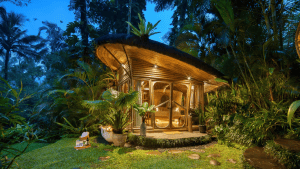
Move from elevated, tree-level structures to ground-level bamboo villas, and the names change, though the material stays the same.
Green Village, designed by Elora Hardy's studio IBUKU along the Ayung River in Sibang, is a cluster of custom-built bamboo homes within walking distance of the Green School. Each house is engineered and hand-built from bamboo alone, with the studio treating it as a structural material capable of standing for a lifetime rather than a decorative one. A share of the proceeds from each house funds scholarships at the neighbouring school.
Veluvana Bali, on a hilltop in Sidemen, was built by local Balinese artisans using natural materials, with Mount Agung on one side and the valley's rice terraces on the other. It leans further into the eco villa bracket than the open-air treehouse category, with enclosed rooms rather than tree-level platforms.
Hideout Lightroom, a minimalist bamboo cabin with a private garden and valley views, sits at the more enclosed end of our own collection, built for guests who want the material and the setting without sleeping fully open to the air.
The material stays the same across all three; it's the amount of open air that changes.

Glamping in Bali usually means canvas over a solid frame rather than bamboo walls, with the comfort turned up and the footprint kept small.
Sandat Glamping Tents, a short drive from central Ubud, spreads eight rooms across a rice paddy in tiers: safari-style tents divided by bamboo screens on the lower level, and three rice-barn lumbung rooms with traditional thatched roofs above. There's no television or phone in the rooms, and guests summon the butler with a small wooden instrument instead.
Hay House, a premium bamboo glamping hut, is our answer to the same idea: canvas and bamboo working together rather than one standing in for the other, set into the quieter end of the East Bali valley.
It's a comfortable way to try sleeping closer to the outdoors without committing to it fully.
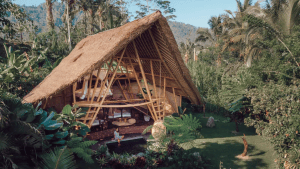
A jungle resort in Bali usually means more forest cover and fewer neighbours than the rice-terrace villas further down the valley.
Munduk Moding Plantation Nature Resort, over a thousand metres up in North Bali's highlands, is built into a working coffee plantation surrounded by forest, with an infinity pool that's been shortlisted among the world's best. The resort runs on a mostly Balinese team and channels part of its programme into supporting the surrounding villages, worth asking about directly if community impact matters to your choice.
Bali Silent Retreat, in the foothills of Mount Batukaru near Tabanan, has run on an off-grid, no-wifi ethos since 2013, growing most of what it serves in its own gardens. It sits closer to a meditation centre than a conventional resort, so it suits travellers after structure and quiet over a pool and a bar.
Hideout Horizon, an open-plan bamboo house facing the jungle with a heated plunge pool, is the closest thing in our own collection to this category, built to look straight into the tree line rather than out over open rice fields.
Fewer neighbours and more forest cover tend to come as a pair.
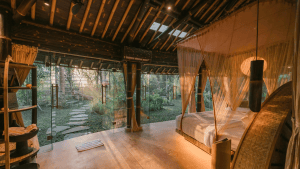
For travellers who want the bamboo-and-jungle setting without sharing a pool, a handful of Sidemen and Selat villas build a private plunge or infinity pool into every house rather than one shared feature for the whole property.
Camaya Bali, in Selat, gives each of its bamboo villas its own private pool alongside a hot tub, hanging nets over the rice terraces, and a complimentary scooter for guests who want to explore beyond the property. Being fully open-air on the ground floor, it suits couples more than families with young children.
Hideout Leaf, a designer bamboo villa with a private pool, was created with Pablo Luna Studio and sits at the more architectural end of this category, built for guests who want the privacy of their own water without giving up on design.
Privacy over the pool is the trade most guests in this category are actually paying for.
Ubud has the famous names and, increasingly, the crowds that come with them. Bambu Indah, Green Village and Sandat Glamping Tents are all within a short drive of central Ubud, so a stay there pairs easily with the town's restaurants, yoga studios and rice-terrace walks, at the cost of sharing the road with everyone else doing the same thing.
East Bali, centred on Sidemen and Selat below Mount Agung, trades that convenience for quiet. Camaya, Magic Hills, Veluvana and our own houses sit closer to working rice terraces than to any main road, roughly ninety minutes further from the airport than Ubud.
If you'd like a fuller picture of the area before booking, our guide to where to stay in Bali covers how East Bali compares to the rest of the island, and our things to do in Sidemen guide covers what fills the days once you're here.
Neither region is more eco than the other by default. The material and the intent behind a build matter more than the postcode it sits in.
Start with how much air you want between you and the outside, then work down from there.
We manage only a handful of these houses ourselves, deliberately so. The full collection, all fourteen of our houses, sits alongside the properties named above for anyone comparing East Bali's options in more detail. If none of ours fit what you're after, the names above are a fair place to keep looking, and most are worth the search if you're after one of the more unique places to stay in Bali.
Planning an eco stay in Bali comes with plenty of questions, especially once you start comparing treehouses, bamboo villas and jungle resorts against each other. Here are a few of the things most travellers ask before booking.
There isn't a single best one, since the category spans open-air treehouses, enclosed bamboo villas, glamping tents and full jungle resorts, each suited to a different kind of traveller. Bambu Indah and Green Village are the most established Ubud names, while Sidemen and Selat hold most of East Bali's newer bamboo villas, including our own houses.
Yes, mainly clustered around Ubud and the Sidemen valley. Bambu Indah has open-air treehouses among its restored Javanese homes, and several Sidemen properties, including Magic Hills and our own original house, build two-storey elevated bamboo structures that function the same way without technically sitting inside a tree.
It depends on what you're comparing it to. Glamping sits between a hotel room and a bamboo villa: more comfort and structure than an open-air treehouse, with less of the fully immersive feel. For a first eco stay in Bali, or for travellers unsure about sleeping without walls, it's a sensible middle ground.
An eco villa is a private, self-contained house, usually one to three bedrooms, built with lower-impact materials and practices than a standard hotel room: bamboo or reclaimed timber construction, solar power, greywater systems, and local staffing. The private-pool villas above are the clearest examples of the category in Bali.
The two main clusters sit around Ubud, particularly Sayan and Sibang along the Ayung River, and around Sidemen and Selat in East Bali below Mount Agung. The Ubud cluster is older and better known; the East Bali cluster has grown faster over the past decade and tends to sit further from other tourist infrastructure.
They range widely. Simpler bamboo huts and shared-pool glamping tents can cost less than a mid-range hotel, while designer bamboo villas with a private pool sit closer to five-star pricing. Materials and setting drive the cost more than the word eco itself does, so it's worth comparing what's actually included rather than the label.
The best eco stays rarely announce themselves as such. They come from a property that's happy to explain where its water goes, who built the beams overhead, and why the pool is heated the way it is, not just the one with the best photograph.
If a bamboo house above a river in Sidemen sounds like the right kind of quiet you need, Hideout Bali was built around exactly that. Hideout Bali's wider collection sits alongside the properties named above, for anyone weighing up which type of eco stay actually suits them.
Bali still has plenty of genuinely low-impact places to stay, so the choice doesn't have to be a guess. Choose the eco resort in Bali that does what it says, not just the one that photographs best.


